

By Autumn Demberger, Global AgInvesting Media
Fertilizer is fundamental to life on Earth, directly supporting half of global food production and sustaining approximately four billion people. Yet, it has its pitfalls. Farmers across the globe understand the high expense associated with fertilizer, often accounting for nearly 30-40% of their annual budget, depending on crop. They also understand its limitations, especially when supply chain disruptions and geopolitical tensions drive lack of access and price volatility. And that’s not to mention its contribution to agricultural runoff and leaching.
Yet, farmers also understand that without fertilizer, there is no food.
That’s where Switch Bioworks comes in. Described as “the living fertilizer company,” Switch Bioworks was built on the idea that fertilizer is the bedrock of crop production—and it does not need to be a costly and high-energy-intensive thing. The team has engineered naturally occurring microbes that produce fertilizer directly onto plant roots. This in turn lowers costs, supports food security, and welcomes a new level of sustainability into production.
CEO and founder Tim Schnabel shares more below.
Global AgInvesting: What inspired you to found a company like Switch Bioworks?
Tim Schnabel: I’m driven by impact. What’s the biggest problem I could solve? Fertilizer is one of those engineering grand challenges that’s not on too many people’s radar.
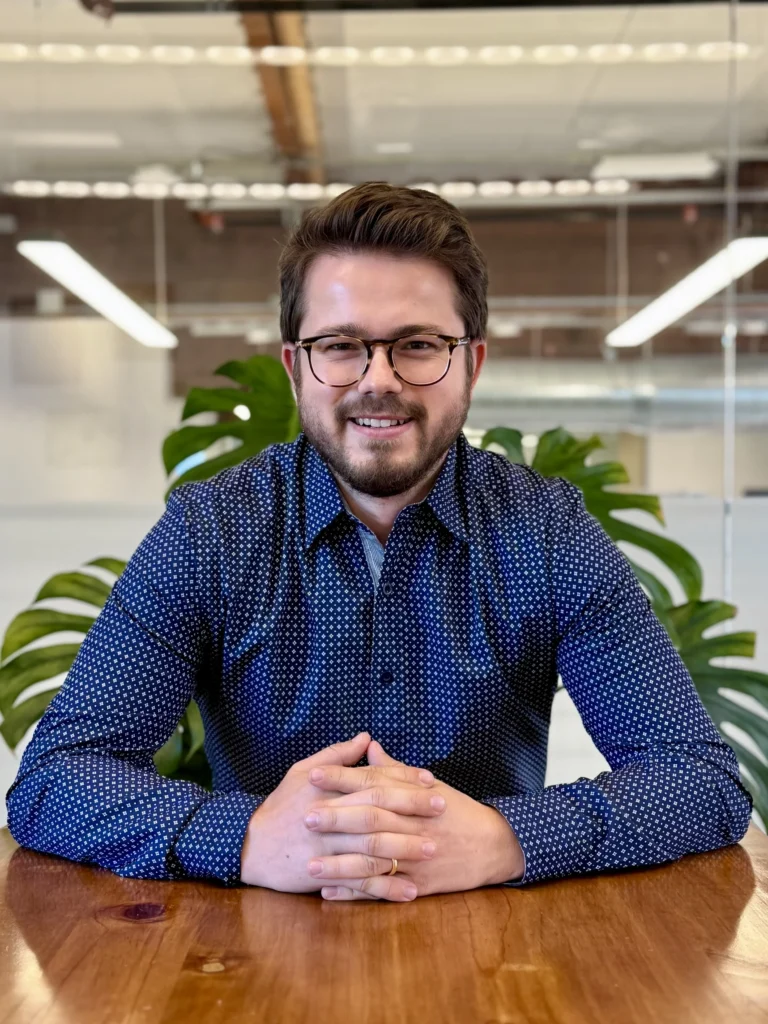
On the one hand, it’s the basis of our food chain, supporting over four billion people through crop production. On the other hand, it’s a huge climate-killer, releasing over a gigaton of CO₂- equivalent emissions every year—that’s more than all cars in the U.S. That’s why we need to reinvent fertilizer. It’s also what makes plants greener—and I love plants; they’re like my pets!
GAI: How did you get your start in this industry? What has been your career journey?
Tim: I studied Chemical Engineering, Economics, Bioengineering, and Entrepreneurship at Stanford for over a decade before spinning out Switch.
The company is only four years old, but I’ve been working on this since my PhD project—which is where some of the founding IP we licensed came from. I didn’t know all along that I’d end up doing this—starting a company. In fact, I didn’t know until right before it happened.
Despite having taken and taught classes in entrepreneurship, I wasn’t sure I’d actually be able to do it. The practical reality is a whole other level above the theory—being a startup CEO is like driving over a cliff and assembling a plane on your way down.
The deciding moment was a mentor, who told me to “make the move without regrets.” And I realized that if I didn’t try, I’d forever be wondering, what if I had?
GAI: When it comes to fertilizer, Switch Bioworks supports a phrase, “It’s critical, not optional.” What does this mean to the company, and on a deeper level, what does this mean for you?
Tim: Without fertilizer, we cannot grow even half the amount of food we need to feed the world. We are wholly dependent on it—and it’s a vulnerable system.
Look at what’s happening in the Middle East right now. A third of the world’s fertilizer passes through the Strait of Hormuz. Geopolitical conflict in that region is choking our food supply. Fertilizer prices are rising, and farmers can’t afford to spend more—it’s already one of their most expensive inputs. In some parts of the world, food prices will rise; in others, there simply won’t be enough food.
Critically, this isn’t the first time this has happened. Think back just four years to the [start of the] Russia-Ukraine war. It’s a pattern. And it will keep happening until we fully reinvent fertilizer—and we think we can do that with biology at Switch.
GAI: How do your microbes work to replace fertilizer and make farming more sustainable?
Tim: Some microbes have the ability to take nitrogen gas out of the atmosphere and turn it into ammonia—which is fertilizer—through a process called nitrogen fixation. We engineer those special microbes, which we isolate from the natural plant microbiome, so they share the ammonia they’re making with plants.
It’s an intricate balance, though—because as soon as they start sharing ammonia, the microbes become less competitive.
Fixing nitrogen and making ammonia is a lot of work, so doing that nonstop has tradeoffs. We control that with genetic switches—hence the name Switch Bioworks—that regulate the timing of ammonia release. This allows the microbes to thrive and make a home for themselves on plant roots prior to fertilizer production.
The product is made of live microbes that we formulate into a powder. It is applied at planting—either in-furrow or as a seed coat. The microbes grow and colonize around the plant roots, and after several weeks, the ammonia release mechanism switches on. At that point, we’re effectively producing fertilizer in the soil.
GAI: Your team is primarily made up of scientists and bioengineers. What is the thought process behind this? How does this team help advance your company’s mission?
Tim: Whenever there’s a fertilizer crisis, people urgently look for immediate solutions. But the reality is—there are none. Otherwise, we wouldn’t be having this crisis.
Reinventing fertilizer from the ground up, like we’re doing at Switch, takes disciplined R&D. To make biofertilizer work reliably for farmers, we need to engineer not just one microbe, but teams of microbes. We need precise time control and ammonia release. Then we need bioprocess development to scale it, along with IP, regulatory expertise, and more.
It’s a complex challenge.So we’ve assembled scientists and advisors from around the world to work on it. It’s an incredible team, and a real privilege to work with them. These are the people who will change the world.
GAI: Why is sustainable farming important for the Earth? What is your company’s long-term goal/vision for making farming more sustainable?
Tim: If we want to make farming more sustainable, we need solutions that also make it more profitable. No one is paying a green premium at scale. Biofertilizer is a unique opportunity to do both at massive scale. We’re looking at replacing hundreds of pounds of chemical nitrogen with an ounce of microbes—that’s fundamentally cheaper to produce.
While we’re building our main product lines for the U.S. and Brazil, we also have impact projects in sub-Saharan Africa. There, we’re not just replacing a less sustainable input—we’re increasing access to fertilizer in the first place, so communities can grow more food, spend less time farming, and invest more time in development and education, for example.
GAI: What are future plans for Switch Bioworks?
Tim: Our mission is to feed the world sustainably. We’re well on our way to developing the most sophisticated biofertilizer the world has seen—but that’s not the end.There’s a broader movement happening.
Our economy has been defined by old-world industrialization—heavy machinery, energy-intensive processes, centralized manufacturing, shipping heavy materials around the world. The future is about building with biology to make what we need, where we need it, when we need it—biology on demand. In this future, medicines could be grown like plants. Our gut microbiomes could act as personal physicians. Coding will mean coding in DNA.
As we engineer biology to produce what we need on demand, we’ll need platforms like the one we’re building—around microbial discovery, genetic engineering tools, and switchable control of biological outputs to balance fitness and production.
So, looking into the future, I see Switch as one of the generational companies that defines our next economy, at its core an R&D engine covering many verticals. I am definitely optimistic that this future will come. The question is: who will join us in building it?
The content put forth by Global AgInvesting News and its parent company Arc Network LLC is intended to be used and must be used for informational purposes only. All information or other material herein is not to be construed as legal, tax, investment, financial, or other advice. Global AgInvesting and Arc Network LLC are not a fiduciary in any manner, and the reader assumes the sole responsibility of evaluating the merits and risks associated with the use of any information or other content on this site.