

By Editor, Global AgInvesting Media
As global institutional capital searches for inflation-resilient real assets, the conversation around agricultural investment is undergoing a type of structural shift. Where farmland allocation was historically evaluated almost purely on cash crop yield and physical land appreciation, institutional limited partners (LPs) are now evaluating real assets through a multi-dimensional matrix of regulatory disclosure, carbon verification, supply chain resilience, and precision technology, as FarmTogether reported at the end of 2025.
Driven by an expanding global market for nature-based solutions—where private capital deployment has scaled to over $14 billion annually—allocators are increasingly requiring verifiable natural capital metrics alongside core income.
At the center of this transition sits Europe. Far from being just a regional market, the European agricultural landscape has evolved into a key regulatory and operational testing ground for global institutional capital. How European fund managers (GPs) and commercial operators are adapting to rigorous EU reporting standards, deploy biological inputs, and monetize ecosystem services will inevitably help define the playbook for allocators across North America, Latin America, and the Asia-Pacific region.
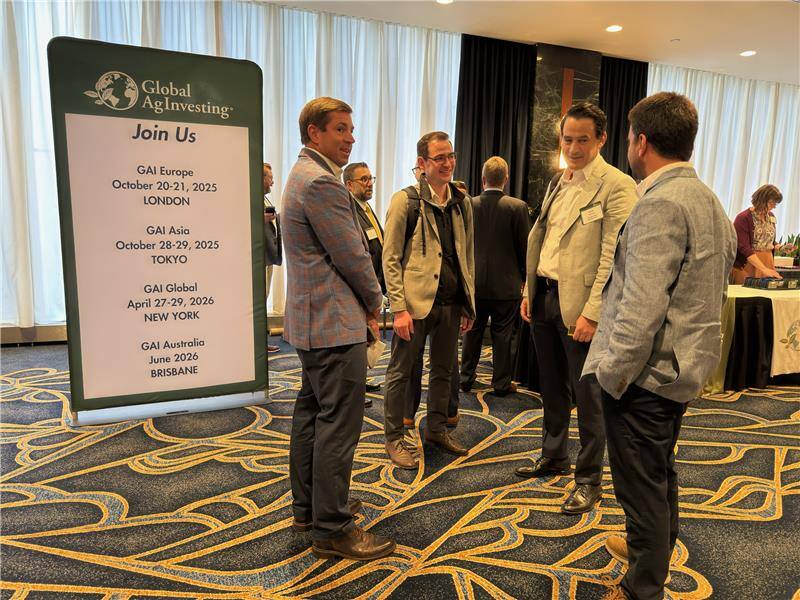
On October 12–13, 2026, asset allocators, agribusiness executives, and agtech pioneers will convene at the Rosewood London for GAI Europe 2026. Beyond providing a venue for direct dealmaking, this year’s forum offers global investors a clear view into the frameworks shaping the future of global real asset allocation.
Regulatory Compliance as an Asset Class Driver
European regulatory mandates, ranging from strict deforestation compliance to corporate sustainability reporting directives, have historically been viewed by global allocators through a lens of risk management. Today, however, that perspective is flipping as institutional investors deploy tens of billions into natural capital strategies that leverage these structured frameworks. European asset managers are pioneering models that turn regulatory alignment into a measure of long-term asset value and leasing competitiveness.
A central highlight of the GAI Europe 2026 agenda is a focused panel examining ESG Investors and the Ag Sector. The session features Tamara Tosic, Senior Investment Professional at the European Bank for Reconstruction and Development (EBRD), alongside Tony Greenham, Chief Impact Officer at the Food, Farming and Countryside Commission.
Tosic, who originates debt and equity investments across Central and Eastern Europe and Central Asia, brings critical transactional clarity to how sustainability-linked financing and climate-resilient business models operate in. Together with Greenham’s extensive policy background, the discussion underscores a vital takeaway for non-European allocators: European operators are helping establish benchmarks for verified impact reporting, dual-bottom-line returns, and climate risk mitigation that global LPs will increasingly encounter across jurisdictions.
Decoupling Natural Capital Hype from Institutional Yield
A rapid acceleration of institutional capital toward carbon forestry, biodiversity credits, and soil health initiatives has created both opportunity and valuation complexity for institutional portfolios. According to industry reports, the top 50 global institutional investors have committed nearly €80 billion to natural capital, making the separation of verified cash flow from speculative metrics a top priority for fund managers.
GAI Europe will address this landscape through sessions, like the “Setting Expectations for Natural Capital in an Institutional Portfolio,” led by Antonio Capitali, Founder and Managing Director of MPO. The event agenda aims to cut through market noise to evaluate cross-border valuation models and risk-adjusted return profiles.
Operational AgTech and Global Supply Chain Agility
Beyond policy and carbon markets, broader market trends point toward structural shifts in farm-level inputs, most notably a growing shift toward biologicals, precision management, and supply chain transparency as input costs fluctuate. As operators adapt to shifting trade policies and input market pressures, farm-level operational efficiency has become essential to protecting yield stability.
This dynamic will be explored during the session “Geopolitical Fracture Lines: How Trade Reconfigurations Are Redrawing the Ag Investment Map,” featuring Nataliya Johnson, Founder of Vasant Capital. The panel will highlight how supply chain reconfigurations across the UK, CEE, and global markets require fund managers to build strategic portfolio agility. Complementing this macro view, sessions on farm-level technology deployment illustrate how commercial operators are deploying field-level automation and biological tools to manage input costs and maintain operational resilience.
The Preeminent Gathering for Global Real Asset Leaders
Hosted at the historic Rosewood London, GAI Europe 2026 pairs high-level macro intelligence with dedicated networking. Utilizing GAI’s AI-powered event app alongside curated LP–GP interaction sessions and evening receptions, attendees can efficiently identify partners, review fund performance, and evaluate co-investment opportunities.
Whether you are managing a pension fund assessing European real asset exposure, an allocator evaluating timberland diversification, or a fund manager raising capital, GAI Europe 2026 provides the access and perspectives necessary to navigate today’s evolving market.
To view the complete speaker line-up, register for the event, or explore sponsorship opportunities, visit globalaginvesting.com/europe.
The content put forth by Global AgInvesting News and its parent company Arc Network LLC is intended to be used and must be used for informational purposes only. All information or other material herein is not to be construed as legal, tax, investment, financial, or other advice. Global AgInvesting and Arc Network LLC are not a fiduciary in any manner, and the reader assumes the sole responsibility of evaluating the merits and risks associated with the use of any information or other content on this site.